
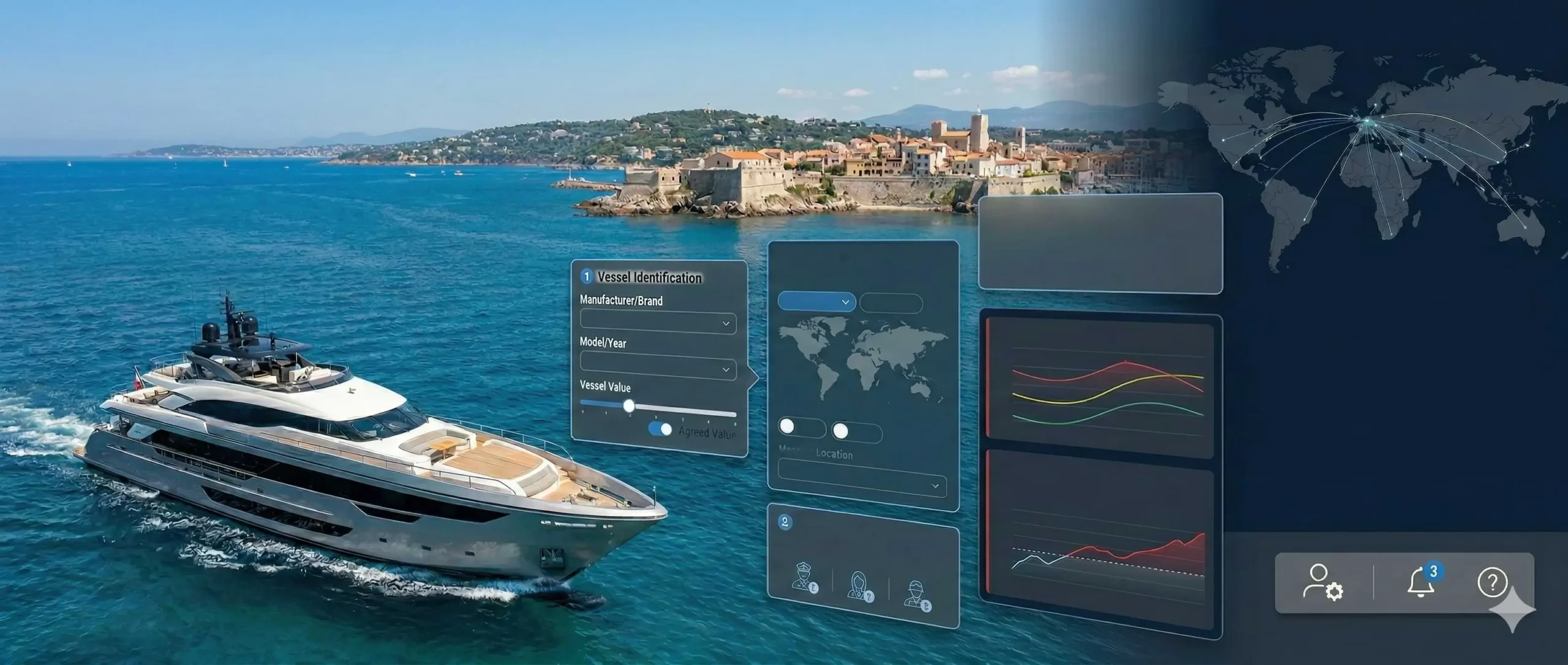
Yacht Insurance Premium & Conditions Calculator Instant Online Estimate
Access real-time insights from the world’s largest marine database to calculate your premium, deductible, and coverage conditions in seconds.
Estimate the Cost to Insure Your Yacht — Instantly
Finding accurate yacht insurance pricing shouldn't require weeks of back-and-forth with brokers. Using the YachtSecure Yacht Insurance Premium Calculator , yacht owners, family offices, captains, and fleet managers can estimate annual insurance premiums, typical deductibles, and recommended coverage clauses in seconds.
This page is designed to demystify yacht insurance pricing and provide real-world insights into marine insurance costs, premium rate calculations, and live market benchmarks — drawn from our team's experience placing hundreds of yacht insurance policies across European, Caribbean, and US waters markets.
Why Yacht Insurance Matters
Owning a yacht is a significant investment with substantial financial exposure: physical damage from storms, collisions, grounding, machinery breakdown, marine liability, environmental risks, and more. A robust marine insurance policy protects both your asset and your liability — but estimating the true cost requires understanding how underwriters actually calculate risk.
Unlike automotive or home insurance, yacht insurance is a specialist line where premium rates vary widely depending on vessel size, flag, navigation zone, and the insurer's current appetite for marine risks. Rates are not publicly listed — they are negotiated individually, which is precisely where an experienced broker adds measurable value.
Based on our live market data, yacht insurance premiums typically range between 0.28% and 1.20% of the insured value annually — with the most competitive rates reserved for high-value superyachts with professional crew and optimal navigation conditions.
How Our Yacht Insurance Calculator Works
To estimate your annual marine insurance cost, our algorithmic calculator evaluates live market data across these key pillars:
Typical Yacht Insurance Premium Benchmarks (2025–2026 Market)
| Yacht Length | Insured Value | Premium Rate | Est. Annual Premium |
|---|---|---|---|
| 40 ft (12 m) | ~€500,000 | 0.80% – 1.20% | €4,000 – €6,000 |
| 60 ft (18 m) | ~€1,500,000 | 0.55% – 0.75% | €8,250 – €11,250 |
| 80 ft (24 m) | ~€4,000,000 | 0.40% – 0.55% | €16,000 – €22,000 |
| 100 ft (30 m) | ~€8,000,000 | 0.32% – 0.45% | €25,600 – €36,000 |
| 120 ft+ (36 m+) | €10,000,000+ | 0.28% – 0.35% | €28,000 – €35,000+ |
About This Calculator — Data & Expertise
The YachtSecure premium calculator is built on real insurance placement data from our specialist marine brokerage, active since 2015. Our team places policies for private yachts, charter vessels, superyachts, and fleet portfolios across Lloyd's of London, European P&I clubs, and specialist marine underwriters worldwide. Rate benchmarks are reviewed quarterly.
The Ultimate Yacht Insurance FAQ
Yacht insurance premiums typically range between 0.28% and 1.20% of the yacht's agreed insured value annually . The most competitive rates — as low as 0.28–0.35% — apply to superyachts over €10M with professional crew and clean claims records. Smaller yachts (under 15m / €500K) generally fall in the 0.80–1.20% range under optimal conditions.
Costs are influenced by vessel value, size, year of build, navigation zone, owner/captain profile and certifications, usage type (private vs. charter), deductible level, claims history, and flag state — all evaluated by underwriters when pricing your specific risk.
Deductibles commonly range between 0.5% and 3% of the insured hull value . Higher deductibles lower your annual premium but increase out-of-pocket costs in the event of a claim. For a €2M yacht, a 1% deductible means €20,000 self-retention per claim.
When you accept a higher deductible, underwriters typically reduce ("load downwards") the base premium rate — a trade-off between upfront premium cost and potential claim exposure. This is often the fastest lever to reduce your annual cost.
Yes — renewals depend on global marine market conditions, macroeconomic factors, your claims history, and any updated survey outcomes. A clean record often translates into stable or improved rates.
Yes — upgrades that increase the vessel's value or materially change its risk profile should be reported to your broker to ensure adequate coverage. Significant upgrades may adjust the premium at endorsement.
Yes — insurers often offer better terms for MCA/STCW-certified crew, extensive captain experience, long-term claims-free records, advanced safety systems, and professional management. Bundling H&M and P&I with the same underwriter can also unlock consolidated pricing.
Yes — AIS transponders, EPIRB, fire suppression systems, bilge alarms, and satellite monitoring reduce your risk profile and can result in premium credits from certain underwriters — particularly on superyachts.
Absolutely. Marine insurance is an unregulated, individually-priced market — the same vessel can attract very different premiums from different underwriters. A specialist broker with access to multiple markets (Lloyd's syndicates, European insurers, P&I clubs) will consistently outperform a direct quote from a single insurer.
Yes — RYA, MCA Yachtmaster, STCW, or equivalent certifications improve your underwriting position and often translate directly into lower premiums, especially for private owner-operated vessels.
Yes — professional captains with verified sea time, tonnage licenses, and relevant endorsements typically secure materially lower premiums. For commercial charters or superyachts, professional crew is often a condition of cover.
Hull & Machinery insurance covers physical damage to the yacht itself — including the hull, engines, generators, onboard machinery, navigation electronics, and fixed equipment. It is the primary coverage in any marine policy and forms the basis for premium calculation.
Yes — most policies include Protection & Indemnity (P&I) coverage, which covers your legal liability toward other vessels, marine infrastructure, passengers, crew members, and environmental pollution arising from an incident.
An agreed value policy fixes the insured sum at policy inception. In the event of a total loss, the full agreed value is paid — without depreciation or market value negotiation. This is the standard and most advisable basis for yacht insurance.
Agreed value is pre-fixed and paid in full on total loss. Market value is based on the vessel's resale price at the time of the loss, which is often significantly lower than what the owner paid — and what replacement actually costs.
The sum insured defines the maximum payout in a total loss and serves as the base on which premium rates are applied. It should reflect the current replacement cost of the vessel, not the original purchase price.
A total loss (actual or constructive) means the vessel is beyond economical repair or completely destroyed. A partial loss covers repairable damage — the more common type of claim. Coverage structures and settlement processes differ between the two.
Generally no. Standard home insurance policies are not designed for marine risks and typically exclude vessels above a minimal value or outside inland waterways. Marine-specific policies are required for proper protection.
While not universally required by law, most marinas, flag states, lenders, charter authorities, and port authorities require proof of valid insurance. Third-party P&I liability is compulsory in several jurisdictions, including parts of the EU and the US.
Yes — older vessels carry higher mechanical failure risk and typically require a recent marine survey as a condition of coverage. Underwriters may apply age loadings, particularly for unattended machinery or older structural materials.
Usually yes, for yachts over approximately 5–10 years old or above a certain insured value. A current condition and valuation survey confirms structural integrity and helps establish the correct agreed value.
Yes — ageing safety equipment (rigging on sailing yachts, outdated fire suppression, old EPIRB batteries) can affect your risk profile and insurability. Underwriters may impose warranty conditions requiring equipment upgrades.
Absolutely — but underwriting for used vessels typically requires a recent survey, and policies may include specific conditions based on the vessel's age, construction, and maintenance history.
Charter operations significantly raise liability exposure, crew complexity, and wear & tear — leading to premium surcharges typically 15–50% above private-use rates . Commercial bareboat charter commands the highest loadings.
A clause that confirms coverage remains valid when a professional captain operates the vessel. This is essential for any commercially chartered or crewed yacht and ensures the policy responds properly when the owner is not aboard.
Yes — loss of charter hire is a standard optional extension for owners who generate revenue from their vessel. It covers lost income when the yacht is under repair following an insured loss.
Crew medical and welfare coverage is typically not included in a standard H&M policy. Owners operating with professional crew should add a crew accident or employer's liability extension — and in many flag states this is legally required.
Only if explicitly declared and valued in the policy schedule. High-value jet skis, tenders, foils, and dive equipment should be itemized individually to ensure proper replacement cover.
Generally not under the standard H&M policy. Personal effects, jewelry, cash, and fine art require a specific personal property extension or a separate floater policy.
Theft of the vessel or declared equipment is usually covered, subject to adequate security measures being in place and any specific anti-theft warranty conditions in the policy being met.
The navigation area defines the geographic boundaries within which the yacht is covered to operate. Leaving a declared navigation zone without prior endorsement from your underwriter risks voiding coverage entirely in the event of a claim.
Yes — worldwide cruising cover is available, but premiums increase to reflect storm exposure, piracy risk, logistical challenges of remote maintenance, and extended periods at sea.
Yes — but itinerary changes must be notified to your broker in advance. Extended navigation endorsements (e.g., transatlantic passages, Pacific crossings) typically carry additional premium and specific conditions.
Yes — a Mediterranean policy extended to include a Caribbean winter season or a trans-ocean passage will attract an additional premium reflecting the increased risk exposure during the extension period.
Navigating outside your policy's declared limits without a prior endorsement can render the policy void, leaving you personally exposed to all loss and liability. Always inform your broker before changing your cruising area.
Most comprehensive policies cover storm and heavy weather damage, but named storm and hurricane conditions often carry higher deductibles or require a documented hurricane preparedness plan. Review the storm language in your specific policy wording carefully.
Insurers operating in Atlantic hurricane zones typically impose higher premium rates, mandatory haul-out requirements between June and November, or named storm sub-limits. Vessels remaining in water through hurricane season face significantly increased underwriting scrutiny.
Yes — ashore dry storage during winter generally lowers risk and can favorably influence premiums. Extended in-water mooring through adverse weather seasons carries higher exposure and may require special conditions.
Yes. Well-protected marinas with security and CCTV present lower risk than exposed coastal anchorages. Your principal port of registry and storage location are underwriting factors, particularly for theft and weather-related damage.
Absolutely. Frequent or large preventable claims lead to premium increases, higher deductibles, or restricted coverage terms at renewal. A clean claims record is one of the most valuable factors in maintaining competitive premium rates over time.
Standard exclusions include: racing and competitive sailing, war and piracy (unless specifically endorsed), deliberate or wilful damage, normal wear and tear, gradual deterioration, and navigation outside declared limits. Always review the exclusions schedule carefully before binding cover.
Not automatically. Racing and regatta participation significantly increases collision and dismasting risk and typically requires a racing risk endorsement added to the base policy — or, for serious racing programs, a dedicated racing policy.
Standard P&I coverage includes passenger liability, but payout limits, medical expense sub-limits, and the definition of "passenger" vary significantly between policy wordings. Verify the passenger limits match your actual exposure.
Damage caused by your anchor or anchor chain to underwater cables, pipelines, or other infrastructure is typically covered under P&I liability, though specific exclusions and sub-limits may apply. Confirm details with your underwriter.
Most yacht P&I packages include environmental liability cover for sudden and accidental pollution (e.g., fuel spills following a collision). Higher limits may be required for commercial vessels or operations in environmentally sensitive areas.
Often yes, under P&I extensions — but the financial sub-limits and definition of "clean-up obligation" vary by policy and jurisdiction. Vessels operating in waters with strict environmental legislation (EU, US) should verify adequate limits.
Comprehensive policies typically include wreck removal and seabed clearance costs mandated by local authorities following a total loss. This cover is essential — wreck removal orders can run to millions of euros, regardless of vessel size.
Yes — towing, emergency salvage, and assistance costs can be included or easily added as low-cost extensions. Given that a single commercial salvage operation can cost €50,000–€500,000+, this coverage is highly advisable.
Yes — fleet policies exist for owners, family offices, syndicates, and charter operators managing multiple vessels. Consolidated fleet programs typically offer economies of scale and simplified administration versus individual vessel policies.
Yes — most policies can be endorsed mid-term to reflect changes: adding a new tender, adjusting the navigation zone, entering a shipyard for refit, or modifying the agreed value. Adjustments are pro-rated and require explicit underwriter approval. Your broker manages this process on your behalf.